Skip to content

Understanding How Salt, Freeze-Thaw Cycles, and Moisture Impact Concrete in Cold Climates
Rochester winters are not gentle. Snow piles up. Road salt sticks to tires. Slush melts into puddles. Then temperatures drop again overnight. This cycle repeats for months.
Your garage floor absorbs all of it.
Without protection, concrete slowly deteriorates under this constant freeze-thaw stress. However, polyaspartic floor systems are designed to handle exactly these conditions. At Profeta Garage Floors, we install coating systems built specifically for Northeast winters.
Here is why polyaspartic floors perform so well when temperatures drop.
Salt is concrete’s hidden enemy
Road salt does more than leave white residue behind. It penetrates porous concrete and accelerates surface breakdown. Over time, this causes scaling, flaking, and surface erosion.
Concrete naturally absorbs moisture. When salty water soaks in and then freezes, it expands. That expansion creates internal pressure inside the slab. Eventually, the surface weakens and begins to break apart.
The Federal Highway Administration has documented how deicing salts accelerate concrete surface deterioration through repeated freeze-thaw cycles and moisture penetration. While their research focuses on infrastructure, the same chemical and environmental principles apply to residential slabs.
Polyaspartic coatings prevent this process from starting.
Because the system creates a non-porous barrier, salt and moisture remain on the surface instead of soaking into the slab. This protective layer dramatically reduces long-term salt damage.
Instead of absorbing winter, your garage floor repels it.
Freeze-thaw cycles demand flexibility
Rochester weather often swings above and below freezing within the same week. Concrete expands when it absorbs moisture and contracts when temperatures drop. That movement stresses the slab repeatedly.
Polyaspartic coatings are more flexible than traditional concrete sealers. This flexibility allows the coating to move with the slab instead of cracking under pressure.
As a result, the system remains intact even when temperatures fluctuate rapidly.
This flexibility is especially important in attached garages, where interior warmth meets outdoor cold. The coating must tolerate temperature shifts without losing adhesion.
Moisture resistance prevents long-term deterioration
Snow melts off vehicles and forms puddles on the garage floor. In uncoated concrete, that moisture slowly seeps downward. Over time, repeated exposure leads to cracking, staining, and weakening.
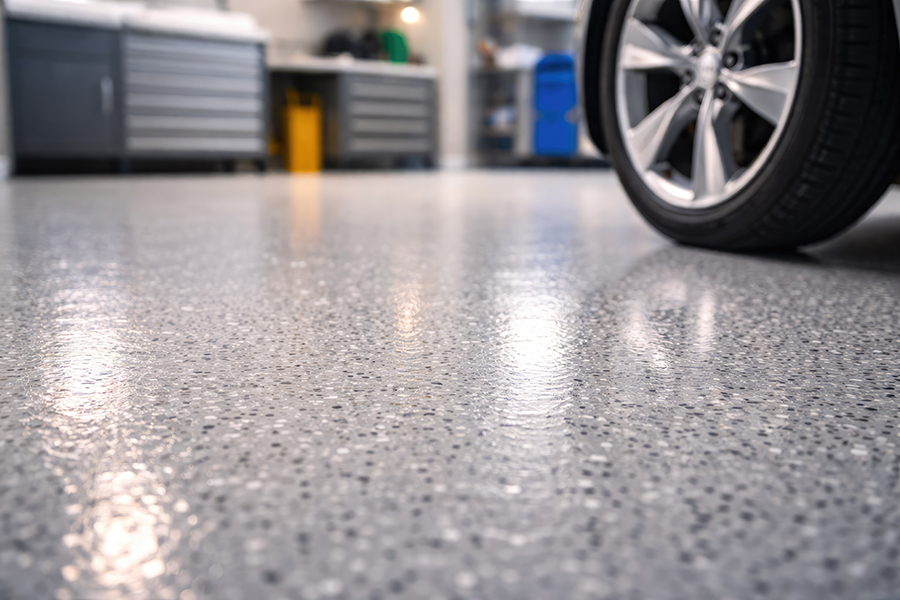
Polyaspartic floor systems create a seamless, moisture-resistant surface. Water stays on top and can be easily cleaned or squeegeed away. Because moisture cannot penetrate the slab, long-term deterioration slows dramatically.
Additionally, eliminating concrete dust improves indoor air quality. Bare concrete sheds fine particles as it wears down. Coated floors prevent that breakdown.
Fast curing works in colder conditions
Traditional epoxy systems can struggle in cold environments. Low temperatures slow curing times and complicate installation.
Polyaspartic coatings cure much faster and perform well across a wider temperature range. This allows installation even during colder months, which is important in climates where winter lasts nearly half the year.
At Profeta Garage Floors, we often install systems during winter so homeowners can enter spring with a fully protected space.
Fast curing also means less disruption. Most systems are ready for foot traffic within hours and vehicle traffic shortly after.
Traction matters in winter
Slush and melted snow can create slick conditions. A quality polyaspartic system includes traction additives that improve grip without sacrificing cleanability.
Bare concrete can become unpredictable when wet. A properly textured coated surface offers consistent traction, even during messy winter months.
Safety is not an afterthought. It is built into the system.
Easier cleanup saves time
Winter garages require constant cleaning. Salt residue, dirt, and debris accumulate quickly.
Because polyaspartic floors are seamless and non-porous, cleanup becomes simple. Salt does not embed itself into the surface. Oil and grime wipe away instead of soaking in.
Homeowners often tell us that maintenance becomes dramatically easier after installation.
When spring arrives, there is no permanent damage to undo.
Long-term protection pays off
Replacing damaged concrete is expensive. However, preventing that damage is far more cost-effective.
A professionally installed polyaspartic system protects the slab year after year. It shields against salt, moisture, impact, and abrasion. More importantly, it slows the natural aging process of concrete.
At Profeta Garage Floors, we design systems specifically for Rochester’s climate. We understand what winter does to unprotected slabs because we see it every season.
Protecting concrete is not about aesthetics alone. It is about durability.
Winter will not get easier. Your floor can.
Rochester winters are predictable in one way. They are tough.
Snow, salt, and temperature swings will continue every year. The question is whether your garage floor is prepared to handle them.
Polyaspartic coatings offer flexibility, moisture resistance, salt protection, and fast installation. They transform porous concrete into a sealed, resilient surface built for Northeast conditions.
If your garage floor shows signs of winter wear, it may be time to stop reacting to damage and start preventing it.
Because while you cannot control the weather, you can control how well your concrete handles it.
Contact Profeta Garage Floors today to protect your concrete with a system designed specifically for salt, snow, and freeze-thaw conditions.